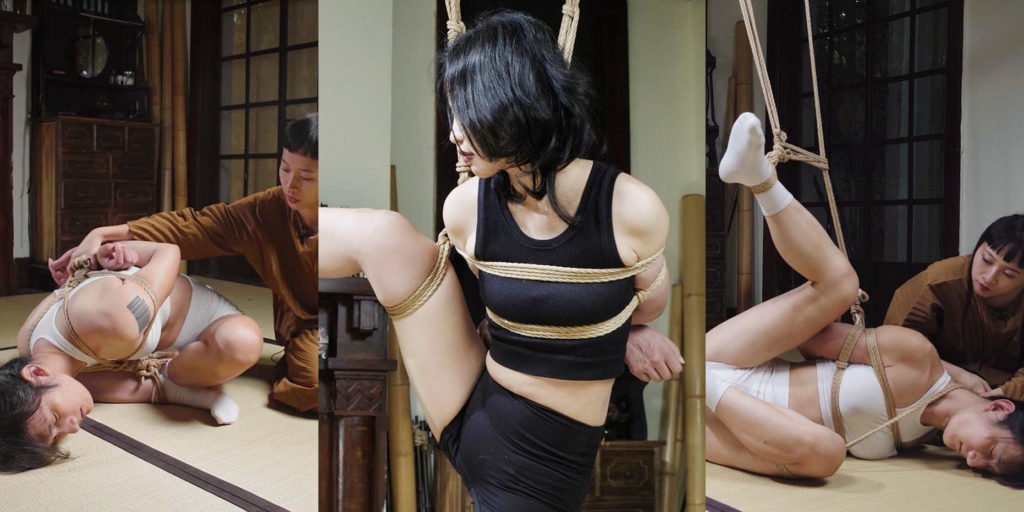
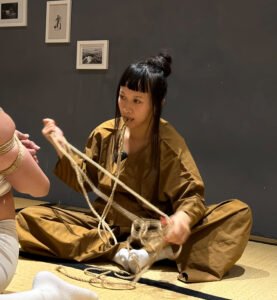
In this online series, we will be exploring the ‘classic’ shapes of shibari, which will be referred to as ‘archetypes’. Even though shibari is still early in its development, there are already clear repeated patterns in its short history. These archetypes have become synonymous with the practice of shibari, particularly rope bondage with a Japanese influence. Shapes such as Kata-Ashi Zuri (one leg suspension), Gyaku-Ebi Zuri (reverse shrimp suspension) and harnesses such as Gote Shibari (hands tied behind the back) are often repeated – let’s delve into why.
What is an Archetype?
An archetype can be any of the following:
1. a statement, pattern of behaviour, prototype, or a main model that other objects copy, emulate, or “merge” into. You could also consider this a “standard example”
2. the Platonic concept of pure form, believed to embody the fundamental characteristics of a thing.
3. a collectively-inherited unconscious idea, a pattern of thought, image, etc, that is universally present, in individual psyches, as in Jungian psychology
4. a constantly-recurring symbol or motif in literature, painting, or mythology. This definition refers to the recurrence of characters or ideas sharing similar traits throughout various, seemingly unrelated cases in classic storytelling and the media. This usage of the term draws from both comparative anthropology and from Jungian archetypal theory.
By looking at shapes as Archetypes, rather than as an ideal form, only then can we understand what is necessary to maintain or what modifications are needed to adjust to the individual experience. We will be exploring how to modify and choose variations depending on skill level, risk assessment, body differences, aesthetics and what kind of mood or sensation you want to focus on. Each Archetype will also include options with and without suspension. The focus will be on adapting to the circumstances and dynamics rather than reaching for an ideal form.
Each class will involve a detailed discussion about each Archetype’s aesthetics, physical and psychological effect as well as how to play with them for different purposes such as versatility for transitions, Semenawa or for sustainability. With demonstrations to show different variations and the option for students to also lab their own version of the archetype.
This series is suitable for all levels, it is also particularly useful for those who are interested in teaching Shibari, as the theory of archetypes this can help to create a more mindful and approachable pedagogy to Shibari education. It comes with an extra introduction video to be watched at your own time and discretion.
January 11th: Gyaku-Ebi
January 14th: M-Shape
January 18th: Torsions
January 21st: Inversions
January 25th: Third Rope for Gote
Event Details
Date & Time: January 11, 14, 18, 21, 25, 4 pm- 7 pm CET (Berlin time)
Format: workshop/demo
Audience: LGBTQIA+ & FRIENDS
Language: English
Minimum Knowledge level: Basic Knowledge of Shibari e.g some context of the culture and consent practices, experience with simple knots and frictions if they wish to tie along
What to bring: Rope if you would like to tie along, and participate with a partner.
Solo or Partnered: All constellations. The ticket price is per person.
Class recording: Yes. The session will be recorded and available for 30 days after the last workshop. The participants will not be recorded.
Accessibility Note
The workshop and discussion are held in spoken English with automated captions in English which are provided by Zoom. Communication within the class can be had via chat but also people can come on mic and speak. If you participate in this workshop and need more assistance, i.e. someone reading out the chat, etc, please message us at info@karada-house.de beforehand.
Who is this event for?
LGBTQIA+ describes the full spectrum of non-mainstream sexual orientation and/or gender identity, meaning: lesbian, gay, bisexual, pansexual, transgender, non-binary, genderqueer/fluid, queer, intersex, asexual, aromantic, agender.
Friends describes people of any and all kinds of gender and sexual identities who are aware and respectful of the necessity, needs, and boundaries of a queer safe(r) space and its marginalized community.
When you consider yourself a friend you show acknowledgement to and are respectful of everyone’s self-expression and do not assume, presume or project non-consensual ideas onto others. You actively request and use people’s chosen pronouns. You remain mindful of the fact that Karada House is first and foremost a space for queer people that you are also invited to attend. You have a genuine concern for the well-being of LGBTQIA+ people and remain in awareness of heterosexual and gender straight privileges.
Friends don’t have to be perfect. None of us are. We request that we all pro-actively work and strive to be good friends and allies to marginalized people.
If you cannot afford the ticket price (even the solidarity price), please send us a message. We will find a way.