Quick Info
- When:
- 9. August 2025, 3:00 pm – 6:00 pm CEST
- Where:
- online
- Format:
- workshop
- Who can join:
- LGBTQIA+ & Friends
- Constellation:
- solo, paired, groups - all constellations welcome (everyone needs a ticket)
- Language:
- English
- Recording:
- Yes, the session is recorded and will be sent to all ticket holders after the class.
- Questions:
- Message us via info@karada-house.de
- Add to calendar:
- Google Calendar / iCal / .ics file
Tickets
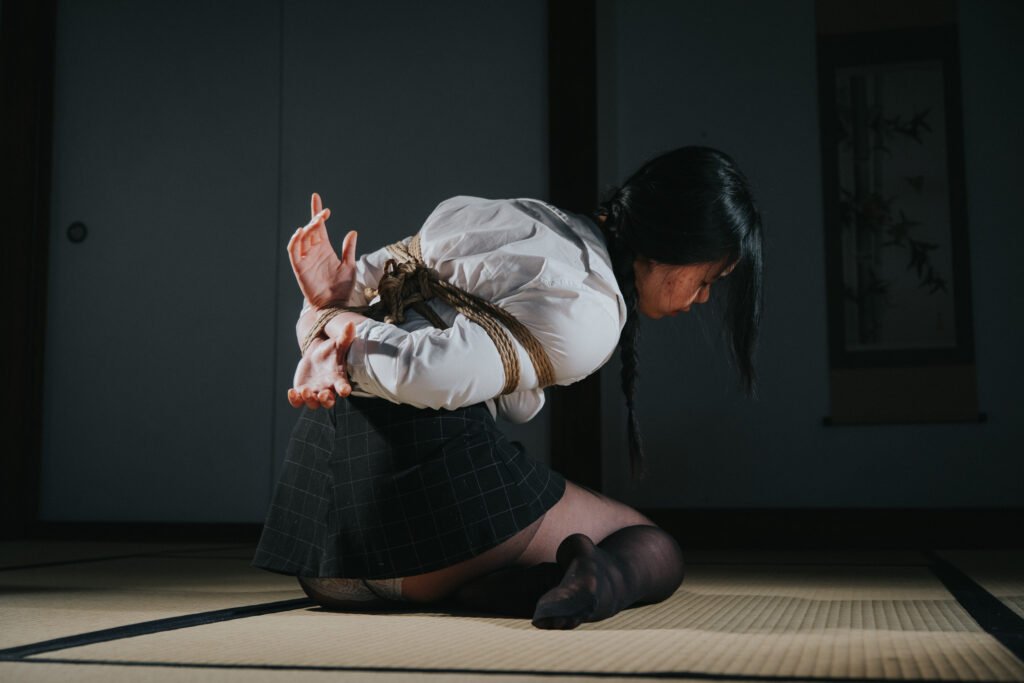
Gote Shibari is one of the most iconic and foundational ties in Japanese rope bondage. In group workshops, especially for beginner and intermediate students, it is often taught as a fixed form. This helps students focus on learning essential technical components. While this approach is valuable for building solid rope techniques, it often leaves little space for exploring and understanding how to adapt the tie to different people. Personalising the Gote is a nuanced practice that requires experience, observation and deeper insight, which is difficult to explore in a typical group setting.
Naoko believes that no two Gotes are never the same. Whether you are tying someone for the first time or the hundredth, every tie should be responsive to the person in front of you – how they feel on that day, their body, their energy, the conversation you are having in rope, and the space you are sharing. The Gote, in her view, is not a “one-size-fits-all” form but an evolving, living expression of connection.
Adapting Gote Shibari
In this workshop, Naoko will present Gote Shibari as a customisable form through a series of live demonstrations (up to three, time permitting). For each demonstration, she will tie with a different person who has a distinct physique, flexibility and personal preferences. Before tying, Naoko will begin with an open conversation with the person being tied to understand their preferences, needs and context of the tie. She will then tie the Gote specifically for them, adjusting elements as needed while talking through the reasons behind her decisions. In some cases, she may tie more the once to show variations or different approaches. After each demonstration, Naoko and the person being tied will share a debrief to reflect on their experience.
Throughout the class, Naoko will talk through her thought process, sharing insights into how she balances techniques, aesthetics and feelings. She will demonstrate using the technical form of Naka style of Gote as the foundation.
Topics include
– Adapting to different body types (height, weight, muscle, fat, bone structure)
– Navigating flexibility, past injuries and physical limitations
– How tying different bodies have an impact on time, pacing, number of ropes and the overall energy in a session
– Understanding what sensations or experiences the person enjoys in Gote Shibari
– Aesthetic choices based on body proportions – how to tie in a way that honours and highlights the unique beauty of the person being tied
– Finding harmony between safety, structure and emotional connection
Naoko’s approach
This class focuses on individuality. Instead of relying on formulas for specific body types, Naoko encourages a holistic and responsive approach. She avoids placing people into fixed categories like “flexible” or “inflexible” and applying standard techniques based on those labels. Rather, she invites students to consider the full context of the person they are tying, including their body, emotions, preferences, and the interaction at that moment. The goal is not to follow a set method, but to develop awareness and sensitivity in order to create an experience that truly suits the individual.

Facilitator

More Information
LGBTQIA+ describes the full spectrum of non-mainstream sexual orientation and/or gender identity, meaning: lesbian, gay, bisexual, pansexual, transgender, non-binary, genderqueer/fluid, queer, intersex, asexual, aromantic, agender.
Friends describe people of any and all kinds of gender and sexual identities who are aware and respectful of the necessity, needs, and boundaries of a queer space and its marginalized community.
When you consider yourself a friend you show acknowledgement to and are respectful of everyone's self-expression and do not assume, presume or project non-consensual ideas onto others. You actively request and use people's chosen pronouns. You remain mindful of the fact that Karada House is first and foremost a space for queer people that you are also invited to attend. You have a genuine concern for the well-being of LGBTQIA+ people and remain in awareness of heterosexual and gender-straight privileges.
Friends don't have to be perfect. None of us are. We request that we all proactively work and strive to be good friends and allies to marginalized people.
After your successful ticket purchase, you will be sent an email with the Zoom login data for this event. If you do not receive it, message us with your order number so we can send it again. Some email services "disappear" our messages so please check if you received our login data email.
If this session includes a recording you can obtain it by simply purchasing a ticket. You will automatically get access to the live class and the recording as they come in a package. The recording login data will be sent out 24–48h after the live event and will be available for (at least) 14 days after the live event. Please note these classes are places for experience, not for instruction. Nothing here is tested or graded — only perceived, felt, and shared. All offerings are invitations to reflect — no curriculum, no exam, no training. Recordings exist solely to support personal integration and are available only for a limited time.
Yes, because you are paying for the knowledge our facilitators distribute, not for the access to Zoom itself. We kindly ask you to respect that and pay accordingly.
Before purchasing a solidarity ticket, please check here if you are eligible for one.
If you cannot afford this event, please check the ticket option "solidarity" for reduced ticket prices. If that is still too much or they are out of stock, feel free to send us a message via info@karada-house.de.
- Virtual: The session will be held on ZOOM
- Live captions are available
- Live translation in multiple languages is available
- Transcripts of the session are available
- The session is moderated and tech support is available
- Communication in the session is via chat and/or direct communication via microphone