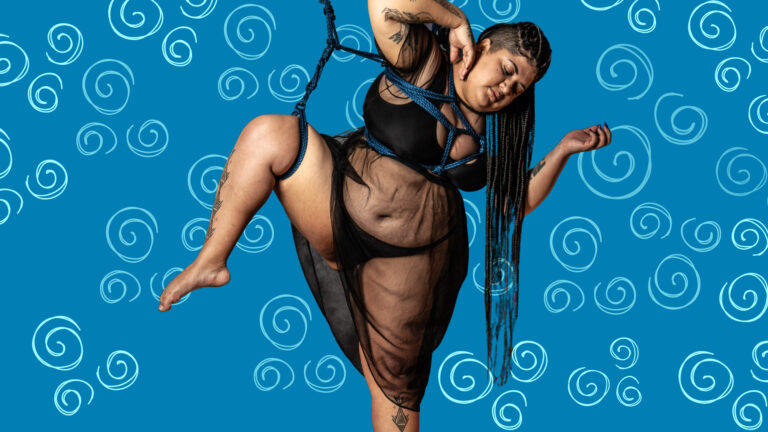

A Quick Guide To Tying Fat People
It’s sadly common for fat people to hear that that our bodies are difficult to tie, we can’t be suspended, and our bodies are problems we should solve. We don’t see ourselves in images, and when we go to spaces, we feel like the odd ones out.
It’s especially tragic because it’s absolutely not true that fat people couldn’t be in rope. Superpowers like protected nerves, inhuman strength, and a body that is easily sculpted into a multitude of forms get so easily overlooked.
Ceci Ferox has compiled these 4 easy steps to start you on the path towards really enjoying the soft a squish of your own or other people’s bodies. To learn more about fat bondage, and to be in community with other softies, join our Thick Hitches conference May 23rd-25th, 2025. It’s going to be epic!

1. Placement
Don’t rely on visual clues on where to place the rope. Fat will trick your eye. Instead, place the ropes according to where muscles and bones sit under the fat. Use natural valleys on the body to anchor rope.

2. Tension
If you are or have ever been fat, you know that fat squishes and moves. When shopping for pants you have the possibility of fitting in a range of two or three sizes. This means you need to tie tighter for the ropes to actually stay in place and have the proper tension. Some fat people can’t tolerate tight ropes, in which case you need to use structure to compensate.

3. Tissue
Some fat is dense and some fat is soft. They need different ways of tying. Extra wraps will work well on solid tissue, but fall into the valleys of soft fat and create extra pressure. Try “michelining” soft fat, leaving a pad of fat between wraps to prevent the rope from scrunching up.

4. Structure
The movability of fat requires more stability from the rope. Wraps also tend to have larger circumferences on fat bodies. Reduce the flexibility of a harness by adding friction structures and cinches along long wraps.