
Reflecting on 20 weeks of Karada House
(December 27th, 2019)
We remember precisely the moment we stepped into the old stable that would become Karada House on a hot July summer day. It is not often that you enter a space and you know right away that this is the perfect match. It was not what we had envisioned, the timing was off, our funding unprepared but standing there in all the dust and dirt, we knew we’d try.
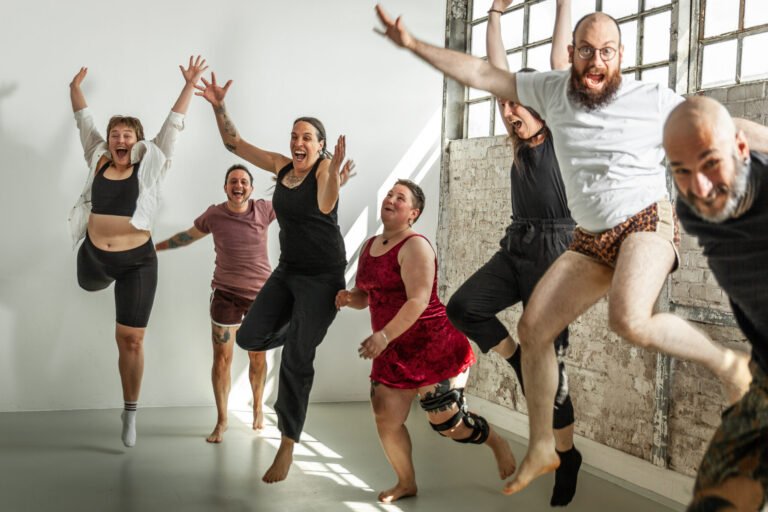
Now, twenty weeks later Karada has become for us and hopefully for some of our visitors, participants and helpers, a sanctuary that lends its space to the most wonderful and wondrous events and moments. Karada House took 3 weeks to build and facilitated 80 events in the 4.5 months that followed. The beginning was pure insanity, what followed was instinctual or through a need to fulfill our own wishes, desires and needs.
Karada is, and this may not be clear to everyone, a collaborative project between Caritia, Mamana and Renée de Sans. This entire house is run by three people. In their free time, with the help of volunteers and supporters. We have yet to wrap our own minds around this fact and that it is working, albeit with a lot of unpaid labour from our side. Karada is our sanctuary, born out of a deep need we had and we are happy to share it with you and also be open about the process.
Now that we allow ourselves a short winter break, we finally get to reflect on what has happened, what we did, what Karada is becoming and where we could improve. We’d like to share our collective reflections with you.
 The lounge area before renovation.
 The stable hall before renovation.
 The bubble room before renovation.
Queer. Safe(r). Space
Karada House is not for everyone. We set out to create a space that is best described as a queer safe(r) space. Queer because we identify as queer people and because we all had the need to experience kink and body work, art and rituals in a queer community. We consciously offer events for a mixed audience as well. Mixed we define as an audience that includes everybody as long as they are allies and understand that a queer safe(r) space is a bit of a different thing, has different requirements and necessities than a predominantly non-queer space.
After giving this a try we have now learnt that:
it is possible and can be extremely fruitful, fun and deeply connecting to have groups that consist of queer people and non-queers that come together on eye-level
in a space like ours that puts its priorities on being a queer safe(r) space it becomes clear very quickly if someone in the house does not respect its rules and its primary audience
mixed groups and groups that are queers and womxn only have very different vibes and energies. Both are great, and we realize that it is indeed good as well as necessary to have spaces solely for queers and womxn where we/they can be amongst ourselves as this allows for a different kind of atmosphere, connection and sometimes healing.

Being safe(r)
We wish to be a safe(r) space. We realize that no space is ever completely safe, however our intention is to put our energy into making it as safe as possible. Therefore we have implemented some rules and regulations. We have a strict door policy and a list of people that are not permitted into the house due to known and/or experienced boundary and consent violations. Currently our list has 22 people on it. We also have an anti-abuse policy in place that is somewhat of an experiment, which is currently working well. The policy aims for prevention, allowing people to listen to their gut feelings about people and situations.
In our house you can call “yellow” and discreetly point at a person that you have a bad feeling about or had an interaction with that made you uncomfortable. We will then keep an eye on that person. You can choose to keep interacting with that person but you know you are not alone and we have your back. No yellows have been called so far.
You can call “orange” if someone’s concrete actions or words make you uncomfortable. These moments are typically in a gray area — moments people often recognize only afterwards as times when they should have walked away or intervened. Orange moments happen right before an actual boundary or consent violation takes place. If someone calls orange in our house, we gently intervene and talk to the person whose actions are worrying others. We stop the situation before boundaries are crossed. The uncomfortable or triggered person is taken out of the situation and supported. We have had 6 orange call-outs for 4 different people so far. Depending on the reactions afterward, these individuals have either been asked not to return or have reflected, learned and stayed part of the house.
Our experience shows that orange call-outs sometimes happen because a person lacks awareness, communication skills, or understanding of their own boundaries. Other times they were deliberate attempts to cross other people’s boundaries.
If you call red, we consider this a clear boundary or consent violation and immediately remove the person from the house. A later meeting is scheduled to discuss the matter when everyone is calm and stable enough to engage in an accountability process. No red has been called so far.
 The stable hall entry before renovation.
 The ramp before renovation.
 The lounge area without pink floor.
Takashi’s Castle Syndrome
Another aspect of being a queer safe(r) space is keeping our own space safe and being firm with our boundaries. This has turned out to be one of the most time and energy consuming tasks. We have come to call a certain dynamic Takashi’s Castle Syndrome. For some non-queer individuals it has become a game or challenge to try to breach our boundaries and see how far they can insert themselves into events that are not for their demographic. We are not surprised that this happens, but we are astounded by the extent of it.
Takashi’s Castle Syndrome falls into three categories:
But I am one of the “good ones” / “different”
Some non-queer individuals argue that they should be permitted to attend queer and womxn events because they consider themselves allies, woke, or non-threatening. They expect to be exceptions to our rules, not realizing that by demanding entry they prove the opposite.
Pure power play
Some non-queer individuals feel challenged by a space that is not for them and cannot accept that fact. They ignore event restrictions, buy tickets anyway, show up and argue, or sneak in. We now have two closed doors because of such individuals. We have also had people try to enter despite being explicitly told they were not permitted due to past behavior.
Queer is a joke
Some individuals ridicule the need for closed queer and womxn spaces, joking about dressing “queer” (pink tights, skirts, etc.) as if this were enough to “pass” and gain entry.

Solidarity is a two-way-street
The call for solidarity within the queer community is something we have experienced deeply. We are grateful for everyone who helped build the space: those who gave time, labor, materials, and financial support. Volunteers help us immensely, and some facilitators and artists even offered their skills for free or reduced rates so we could get started.
We also try to give solidarity back. Most events have soli tickets or sliding scales. You can volunteer and exchange work for workshops. And if someone is struggling, they can message us and we will try to help. Some have told us — indirectly — that our prices feel too high or not inclusive enough. We wish people would tell us directly.
Our prices reflect the need to maintain safety and sustainability. If the space does not receive enough support via ticket sales and occasional supporter tickets, it cannot continue. Solidarity is mutual.
We have also learned that when we give a free ticket, the recipient often does not show up.
Canceling workshops
Our ticket system helps determine whether an event has enough interest to proceed. If numbers are low, facilitators can choose to cancel. Many do, as the risk is too high for marginalized facilitators. We support this, even when it means the space makes no money. This is part of our solidarity principle and explains why we sometimes cancel events.
 Performance by Bishop Black on opening night.
 Performance by Xa Na and Miss Mila on opening night.
 Performance by Gestalta, Shantel Liao & Miauleks.
What we wish to do better
Karada developed very quickly, and in the beginning we were overwhelmed. We made mistakes, especially in communication. It took time to find the right approach. Particularly when dealing with individuals who were not welcome in the house, we could have been clearer and more direct. We plan to improve.
Karada is also a space where pronoun acknowledgement is very important. We always ask — but we also mess up. We are committed to doing better.
We are pleasantly surprised by the number of neurodivergent people visiting us and recognize we have much to learn. We want to better understand how to accommodate and support neurodivergent guests. If you have suggestions for resources, please tell us.
We close in celebration of what we as a collaborative team have created through Karada House. Our deepest gratitude goes out to everyone who has supported us. We acknowledge and salute you. We look forward to what 2020 brings and to your critical and loving feedback.
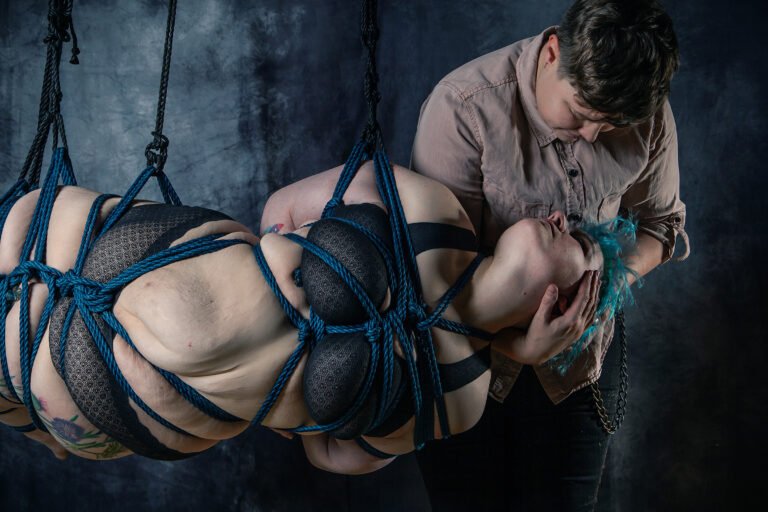
 Shibari photoshoot with Gestalta & OliviaLilith666.
 Self suspension photoshoot with Kaleb.
Over to you
Our house rules state that we are always open to constructive criticism and suggestions for improvement. We have received some already and they were wonderful and helpful. We are, in the end, three people trying our best and running an entire space in our free time. Our view is different from yours. So we would love to hear from you.
If you have been at the house and wish to share constructive criticism, please do. We have heard about misunderstandings discussed with others but not with us.
We encourage and invite you to talk to us or, if you are shy, send us your messages at info@karada-house.de.
Sincerely,
Caritia, Mamana and René